In Quebec, a trailer does not have an easy life. It may roll through snow, face road salt, carry materials to a jobsite, follow an ATV to a trail, haul branches after yard work, or support a contractor on the road every day. That is why the right choice must be practical, safe, and durable.
At Remorques WBA, in Montreal, we help customers choose a trailer adapted to their real needs, whether for work, leisure, residential projects, or commercial use.
Which trailer should you choose in Quebec based on your use?
Before looking at models, you first need to know what you are going to transport. That is the foundation of a smart purchase.For construction materials, wood, tools, soil, gravel, or professional equipment, you need to think about strength, capacity, and ease of loading. A trailer used on a jobsite in Montreal or on the North Shore will not have the same requirements as a trailer used only a few weekends per year.
For recreational use, the need is different. If you transport an ATV, snowmobile, motorcycle, or outdoor gear, you will need a model that is easy to load, stable on the road, and well suited to your equipment.
Frequency of use also matters. For occasional use, a simple utility trailer can do the job very well. For intensive, daily, or commercial use, you need to think long term: frame, axles, brakes, lighting, tie-down points, flooring, and maintenance.
Open, enclosed, dump, flatbed, or galvanized: the right type for the right need
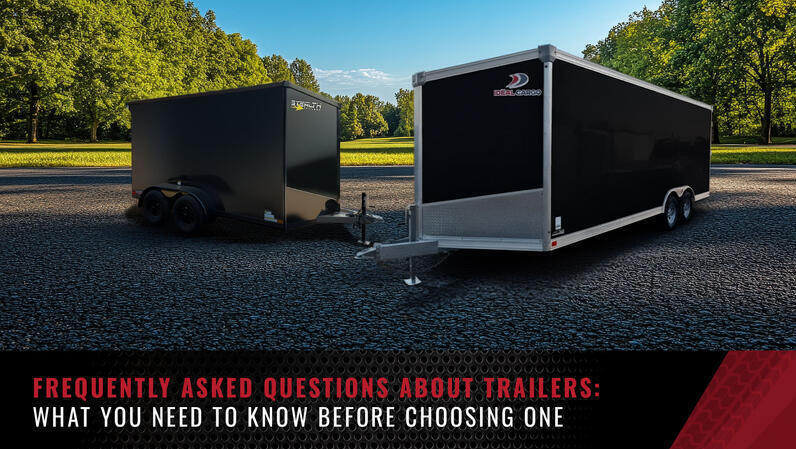
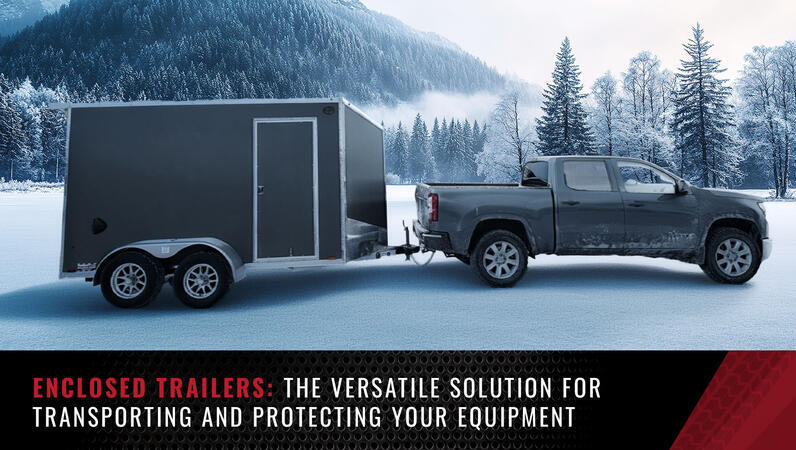
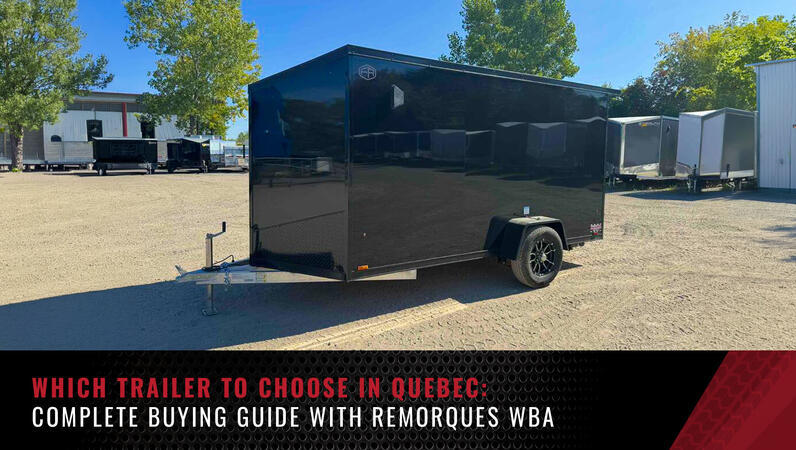
An open trailer is practical for work around the house, small jobs, trips to the eco-center, or transporting equipment that is easy to secure. It is accessible, versatile, and easy to load.An enclosed trailer, often called a cargo trailer, is ideal for protecting the contents. It keeps tools, merchandise, sports equipment, or recreational vehicles sheltered from rain, snow, dust, and unwanted attention. For a contractor or self-employed worker, it is often a very reassuring choice.
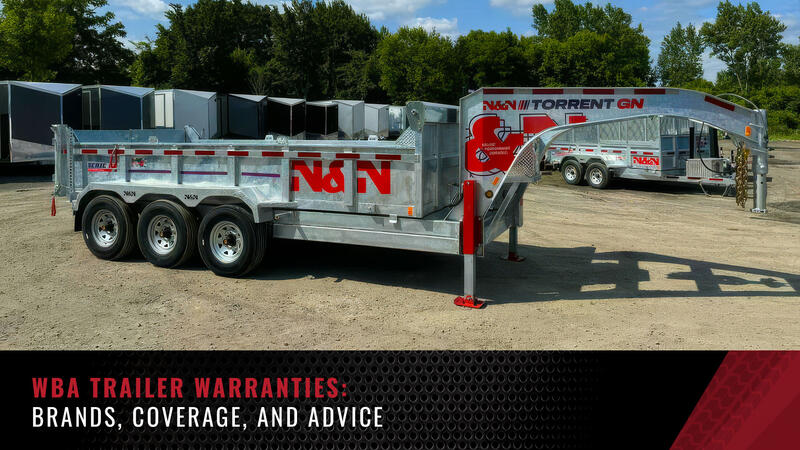
A dump trailer, or tipping trailer, becomes very useful for transporting soil, gravel, debris, branches, or bulk materials. Its main advantage is clear: it makes unloading easier. On a jobsite, in a landscaping project, or for heavier work, it can save a lot of time.
A flatbed trailer is better suited for longer, wider, or more difficult-to-load cargo that may not fit easily into an enclosed box. It is often chosen for machinery, commercial equipment, or oversized loads.
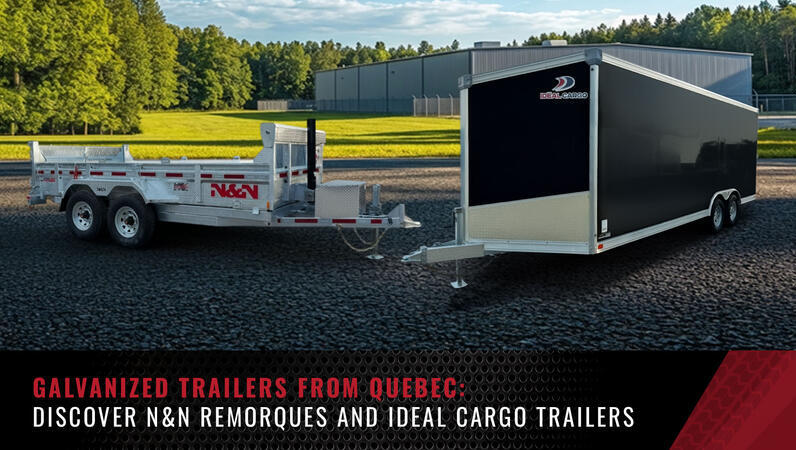
A galvanized trailer deserves special attention in Quebec. With road salt, humidity, snow, and wet roads, galvanized steel is a very relevant choice to help limit corrosion. For an owner who wants to keep their trailer for a long time, it is often a smarter option than simply choosing the lowest short-term cost.
Remorques WBA in Montreal: advice adapted to Quebec roads
In Montreal, needs are varied. Some customers are looking for a trailer for residential work in the east end of the city. Others want to transport professional equipment to different jobsites. Some head toward the Laurentians, Lanaudiere, or the Eastern Townships with an ATV or snowmobile. Others simply need a reliable solution to move material occasionally.At Remorques WBA in Montreal, you can compare several types of trailers: enclosed, utility, dump, flatbed, gooseneck, recreational, custom, or rental trailers. The goal is not to choose “the biggest” or “the most impressive” model, but the one that truly matches your use.
Good advice can prevent a bad purchase. A trailer that is too small quickly becomes frustrating. A trailer that is too heavy can exceed the vehicle’s towing capacity. A poorly adapted trailer can become costly in maintenance, lost time, or daily inconvenience.
GVWR, payload capacity, and towing capacity: the important numbers
This is often where mistakes become expensive. GVWR, or Gross Vehicle Weight Rating, represents the maximum total weight of the trailer with its load. It therefore includes the weight of the trailer itself and everything you put inside it.Payload capacity refers to what you can actually transport. For example, a trailer may look very sturdy, but if it is already heavy when empty, its payload capacity may be lower than expected.
You also need to check the vehicle’s towing capacity. A car, SUV, midsize pickup, and full-size truck do not have the same limits. The owner’s manual remains the reference to consult before purchasing.
Towing a load that is too heavy can affect braking, stability, the transmission, and safety. A trailer should work with your vehicle, not against it.
Single axle or tandem axle: maneuverability or stability?
A single-axle trailer is often lighter, easier to maneuver, and practical for residential use or moderate loads. It is well suited to city driving, driveways, and simpler needs.A tandem-axle trailer generally provides more stability and better weight distribution. It becomes more interesting for heavy loads, longer trips, and professional use. On the highway, with valuable equipment, or in more demanding road conditions, that stability can make a real difference.
The right choice therefore depends on what you transport, the usual weight of your loads, and how often you travel.
Materials and durability: consider the climate before buying
Quebec’s climate must be part of your decision from the start.Painted steel is often more economical, but it requires more attention. Over time, paint chips, humidity, and road salt can encourage rust. For light or occasional use, it may be suitable, but you need to accept a certain level of maintenance.
Galvanized steel is a very strong option for Quebec. It resists corrosion better and is well suited to roads exposed to calcium, snow, rain, and temperature changes. For a utility or work trailer, it is often an excellent balance between strength and durability.
Aluminum is lightweight and does not rust. It may be more expensive to purchase, but it is appreciated by those who want a durable trailer that is easier to tow and less heavy.
The floor also matters. Treated wood is practical and replaceable. Steel mesh can provide good traction depending on the use. Aluminum is light and durable. The right choice will depend on the type of cargo: materials, machinery, ATV, tools, or merchandise.
Brakes, lights, tie-downs, and ramps: the details that change everything
Components make a big difference in everyday use.The braking system is essential once loads become heavier. Depending on the type of trailer and its weight, electric or hydraulic brakes may be necessary or strongly recommended. Electric brakes are common on many work and transport trailers. Hydraulic brakes may also be used depending on the configuration. In all cases, braking must be adapted to the weight being transported and the vehicle doing the towing.
LED lighting is also an excellent choice. It improves visibility, lasts longer, and stands up better to difficult conditions. When you are driving in the rain, snow, or early in the morning, being clearly visible is not a minor detail.
Tie-down points must be numerous enough and properly positioned. A poorly secured load can shift, damage the trailer, or become dangerous. When transporting an ATV, materials, or professional equipment, securement needs to be considered before purchasing.
The ramp also affects the experience. A single ramp may be enough for certain uses. Dual ramps can be more practical for motorized equipment. Swing doors may be better suited to an enclosed trailer used for commercial material.
Legal requirements, plate, insurance, and inspection: do not skip this step
Buying a trailer is not just about choosing a model. You also need to think about the administrative steps.Registration and the license plate must be handled according to the rules that apply in Quebec. Before hitting the road, make sure the trailer is properly registered and compliant with its intended use.
Insurance also deserves verification. Some personal uses may be covered differently than commercial use. The simplest approach is to confirm your liability coverage with your insurer before using the trailer regularly.
Finally, a pre-purchase inspection is always a good idea. Check the condition of the tires, bearings, coupler, wiring, lights, floor, ramps, and tie-down points. A clean, solid, and well-maintained trailer is more pleasant to use and safer.
Conclusion: the right trailer is the one that simplifies your everyday life
Knowing which trailer to choose in Quebec means taking the time to look beyond the model in inventory. It means thinking about your projects, your routes, your seasons, your vehicle, and your safety.A good trailer can follow you for years. It can help you work more efficiently, better protect your equipment, transport your recreational gear, and save time in your travels.
With Remorques WBA in Montreal, you can get personalized advice, compare options, and find a trailer adapted to your reality. Whether you are looking for a utility, enclosed, dump, flatbed, galvanized, custom trailer, or a rental solution, the important thing is to choose a model that works with you, on the roads here.
FAQ
1. Which trailer should you choose in Quebec for residential use?
For residential use, an open utility trailer is often a very good fit. It can transport branches, materials, tools, furniture, or seasonal equipment. If you want to protect the contents, an enclosed trailer may be preferable.2. Is a galvanized trailer a good choice in Quebec?
Yes. A galvanized trailer is very relevant in Quebec, especially because of road salt, humidity, snow, and wet roads. It resists corrosion better than a simply painted structure.3. What is the difference between GVWR and payload capacity?
GVWR represents the maximum total weight of the trailer with its load. Payload capacity is what you can actually transport once the empty weight of the trailer is subtracted.4. Should you choose a single-axle or tandem-axle trailer?
A single-axle trailer is more maneuverable and practical for light or moderate loads. A tandem-axle trailer offers more stability and is better suited to heavy loads, long trips, and professional use.5. Are electric or hydraulic brakes necessary?
They may be necessary or strongly recommended depending on the weight of the trailer and its load. For a heavier trailer, a good braking system improves safety, stability, and control on the road.